
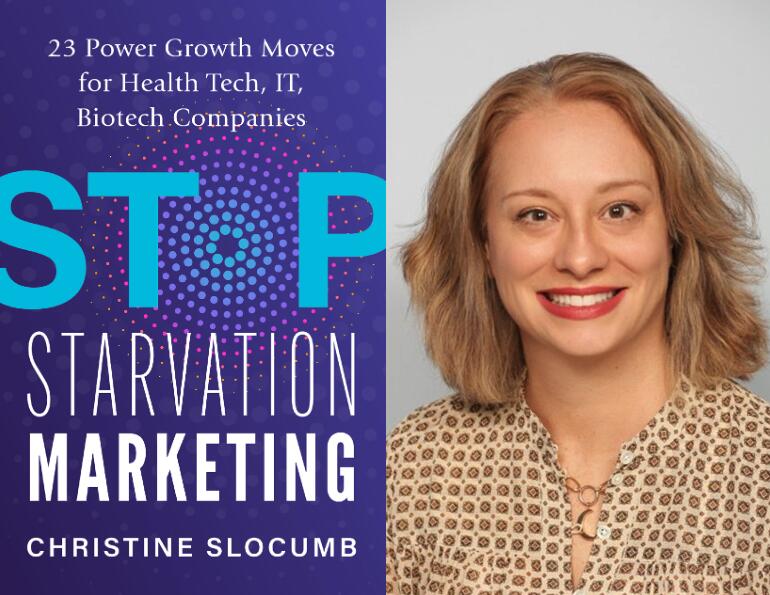
My first book wasn’t supposed to change the trajectory of my business—or my life. It was meant to help my clients.
What I didn’t fully anticipate was how powerful a book could be as a business asset.
That first book quickly became more than thought leadership—it became leverage. I could directly attribute new business to it, including a $40,000 deal from a prospect who simply said, “I saw your book. I have to work with you.” It opened doors to podcasts, speaking engagements, and industry recognition. It wasn’t just a credibility marker; it was a growth engine.
More importantly, it became part of the valuation of my company.
Back in 2022, I published Stop Starvation Marketing for a very specific audience: life sciences and healthcare companies that needed to grow but consistently underinvested in marketing.
As the founder of Clarity Quest Marketing, I had seen the same pattern over and over again: organizations starving the very function that could fuel their growth. The book gave structure to what we were already doing, packaging our insights, case studies, and methodologies into something tangible.
When I eventually sold Clarity Quest to a private equity group building a healthcare-focused marketing holding company, the book—and the intellectual property behind it—played a role in the deal itself. The methodologies we had developed, including what we called the “Tower of Power,” weren’t just ideas anymore. They were codified, protected, and proven. The buyer saw that value immediately and even included rights to that intellectual property in the acquisition terms.
In a service business where differentiation is notoriously difficult, that kind of proprietary thinking matters. You may not have a traditional moat, but you can create one through intellectual property—and a book is one of the most effective ways to establish it.
After the sale, I stepped into the role of Chief Growth Officer within the new organization. Over the next two years, we grew revenue by 88%. And interestingly, the ideas from the book didn’t just fade into the background—they became central to how we sold.
The “Tower of Power” framework became a defining part of our sales narrative. Prospects remembered it. They repeated it. They associated it with us. It gave us a clear, differentiated story in a crowded market. Even years later, people still reference those concepts when they talk about our work.
That experience reinforced something I now firmly believe: a book is not a glorified business card. When done right, it’s a strategic asset that compounds over time.
But if my first book helped me build and sell a business, my second book came from what happened after.
Selling a company is often portrayed as a finish line—a moment of triumph where everything clicks into place. For me, it was anything but simple. The process took three years and pushed me through some of the most challenging moments of my professional life. I didn’t have a roadmap. I didn’t know many people—especially women—who had gone through it. And the resources that did exist focused almost entirely on getting to the deal, not living through what came next.
So I started documenting everything.
I kept a journal during the process, capturing the wins, the missteps, the surprises, and the emotional toll. What went right. What went wrong. What I wish I had known. Over time, I realized I wasn’t just recording an experience—I was building a guide that I wished I’d had from the beginning.
That became my second book, Mastering the Exit Gauntlet.
At its core is a framework I developed to reflect the full journey, not just the transaction. I call it the PATH methodology: Prepare and Align to reach the sale, then Transition and Honor what comes after.
Because here’s the truth that doesn’t get talked about enough: the sale is only part of the story.
After the deal closes, founders face an entirely new set of challenges. You go from being the decision-maker to having a boss—sometimes for the first time in decades. You move from leading your own vision to integrating into someone else’s. And perhaps most disorienting of all, you have to redefine who you are when your identity is no longer tied to the company you built.
That transition can be profound.
For me, it required not just professional adjustment, but personal reflection. What did I want next? What did success look like beyond ownership? How could I honor what I had built while still moving forward?
These are the questions I explore in Mastering the Exit Gauntlet, because they’re the ones I couldn’t find answers to when I needed them most.
Looking back, I see my two books as bookends to a pivotal chapter of my career. The first helped me scale, differentiate, and ultimately exit my business. The second helped me make sense of that exit—and chart a path forward.
If there’s one lesson I’ve taken from this journey, it’s this: the stories we capture and the ideas we formalize have value far beyond what we initially imagine. Whether you’re building a company or preparing to leave one, taking the time to define your thinking can change not just how others see you—but what’s possible for you next.
Editor’s note: Christine Slocumb’s book produced so much more than that first $40,000 sale after publication. Indie Books International is honored to work with her as book strategists and publishers.